
Home › Sanitizing and Disinfecting
Sanitizing and disinfecting in Fort Pierce
Sanitizing and disinfecting in Fort Pierce from Sunrise Sewage Pros: the antimicrobial phase done properly: surfaces cleaned first, then treated with disinfectants rated for sewage contamination, at the right dwell times, across the whole mapped spread and not just the visible stain
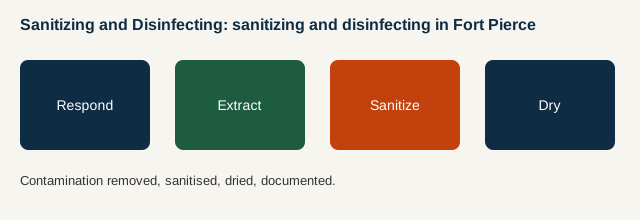
How sanitizing and disinfecting in Fort Pierce works in Fort Pierce
Sanitising is the phase most often faked in sewage work, because it is invisible when done and invisible when skipped. The discipline has a sequence that cannot be shortcut: surfaces are cleaned first, because disinfectant applied over soil and organic matter is spent on the dirt before it reaches the organisms; then the antimicrobial is applied at the concentration and dwell time its rating requires, across every surface the event touched.
The map governs the territory. A sewage event's spread, up the wall base, under the flooring edges, into the subfloor and the adjacent rooms the water reached, is the sanitising scope, not the visible stain in the middle of it. Treating the stain and skipping the wick line is how a house passes a sniff test on a dry day and fails it in the first humid week, which in Fort Pierce is never far away.
Products and methods are chosen for the material: hard surfaces disinfected in place, structural timber cleaned and treated, cavities fogged or wiped where access allows. The record states what was used and where, in plain terms, because a homeowner is entitled to know what chemistry their house was treated with, and an insurer is entitled to see that the treatment matched the water's category.
Signs your property needs the full sanitising protocol
- Any sewage or black water event, however small the room
- A previous cleanup whose smell keeps returning
- Porous structure, timber, subfloor, wall base, was exposed
- The property houses children, elderly or unwell residents
- A rental or business that must be demonstrably safe to re-let
- Flood water crossed the ground floor
Sanitising, or is cleaning enough?
For clean-water events, cleaning and drying are the whole job and sanitising adds little. For sewage and black water, cleaning without disinfection leaves the point of the exercise undone: the contamination is biological, and only the antimicrobial phase addresses it. The water's category, stated at the assessment, decides honestly.
What a Sanitizing and Disinfecting visit covers
A response for sanitizing and disinfecting in Fort Pierce starts with the spread mapped, not with a mop. The affected materials and rooms are assessed, photographed and moisture-read, the findings are explained before anything is priced, and the quote you get is built on what the event actually reached.
The work, when it goes ahead, is verified the same way it was scoped: drying readings taken where the water hid, the treated areas re-read, and the event's findings added to the written record of the property, so the insurance conversation and any future event start from evidence.
- Clean first. Soil and organic matter removed so disinfectant reaches the organisms.
- Apply. Rated antimicrobial applied across the mapped spread, surface by surface.
- Dwell. Contact times held as the products require, not wiped away early.
- Detail. Wall bases, edges, cavities and subfloor treated as the map directs.
- Record. Products and areas treated documented in writing.
What sanitising costs here
Priced within the event's scope by the mapped area and the materials involved, and itemised as its own phase so it is never the invisible line that quietly leaves a quote. Where sanitising is the only phase a property needs, after another firm's extraction, it is quoted as such, from a fresh map.
What proper sanitising prevents
The biological sequel: odors blooming in the first humid week, growth establishing in the wall base, and occupants living over a contamination that was mopped but never killed. It also prevents the argument, with a tenant, a guest or an insurer, about whether the property was ever actually made safe.
Fort Pierce's sewage events follow its ground and its weather: a high water table, storm rain that surcharges old lines, septic districts on the fringes and island properties on shared stacks. A scope written for sanitizing and disinfecting in Fort Pierce here is written for those conditions, not copied from a drier, newer city's checklist.
Other sewage cleanup services in Fort Pierce
See sewage odor removal in Fort Pierce, sewage backup cleanup in Fort Pierce and sewer line break cleanup in Fort Pierce, or return to the sewage cleanup in Fort Pierce homepage.
Frequently asked questions
Is household bleach enough?
Bleach has its uses on small, hard, non-porous spots, and it is the wrong tool for a sewage event: it is spent quickly by organic matter, it does not penetrate porous material, and it gives a cleaned smell that outruns its real effect. Rated antimicrobials, applied after cleaning at proper dwell times, are the professional standard for a reason.
When is the property safe to use again?
After the treatment's dwell and drying requirements are met, which the provider states per room. Hard-floored rooms return quickly; rooms in the drying phase return when readings and treatment are both complete.
Do you sanitise the air and ducts?
Where the event reached them, yes: ductwork that took contamination is assessed and treated as its own item, and air scrubbing runs during the messy phases as standard practice. What the event never reached is not sold as treatment.
Sewage backup in Fort Pierce? Call now.
Available 24/7. You talk with the provider directly before any work is agreed.
The public-health framing of this work is set out by https://www.epa.gov/npdes/sanitary-sewer-overflows-ssos, and it matches the method used here: treat the contamination as the hazard it is, remove what cannot be sanitised, and document what was done. If your property needs sanitizing and disinfecting in Fort Pierce, call +1 (844) 468-2611. We are available 24/7, and you reach the receiving provider directly.