
Home › Blog
What to Do After a Sewage Backup in Your Home
What to do after a sewage backup: the first hour decides how big the job becomes, and the right moves are mostly about what not to do, in the order a Fort Pierce cleanup crew would want them done
First, stop adding water. Everything that drains to the problem, toilets, showers, the washing machine, the dishwasher, makes the event bigger, and a surprising amount of backup damage is done by a household that keeps living normally around it. If a single fixture is the source and its valve is reachable, close it. If sewage is still actively rising, the water main to the house is the household's emergency stop, and using it is not an overreaction.
Second, treat the water as the hazard it is. Keep children and pets out of the affected rooms entirely. Do not wade in barefoot or in shoes you will walk through the rest of the house; contaminated water tracked on soles is how one room's event becomes three rooms' cleanup. If you must cross the area, treat whatever touched the water as contaminated too, because it is.
Third, protect what the water has not reached. Move dry, valued items out of the spread's path, upward and away, handling them with clean hands and only if they are still dry. Do not rescue already-soaked porous items into clean rooms; a wet rug carried through the house is a contamination delivery service. What is soaked stays, and is dealt with as part of the cleanup.
Fourth, document before anything is moved or cleaned, if it can be done safely from the doorway. Photographs and a short video of the rooms, the water's extent and the affected belongings are the foundation of the insurance conversation, and they take two minutes. Insurers argue with memories; they settle with timestamps. Note the time the event was discovered and anything that identifies the cause, a storm, a city crew working on the street, a fixture that failed.
Fifth, resist the mop-and-bleach instinct. Spreading sewage water thinner across more floor does not clean it; it enlarges the contaminated area and drives it into grout lines and edges where it is harder to remove. Ventilate the rooms if you can do so without spreading air through the house's system, and otherwise leave the event contained and alone. A contained event is a scoped event, and scoped events are cheaper.
Sixth, make the calls in the right order. The cleanup provider first, because the damage clock is running and extraction speed is the cheapest variable in the whole event. The insurer promptly after, because policies have notification expectations and the provider's documentation will serve the claim. And if the backup appears to involve the city's sewer, a surcharge affecting several homes, the city's line belongs in the record too, which the provider's assessment will help establish.
A note on neighbours and the street, because Fort Pierce backups are sometimes not private events. If the drains of several homes on the street are misbehaving together, or a crew is working on the sewer outside, say so on the call: a surcharge event changes the cause, the claim and sometimes the responsible party, and the earlier that pattern is recognised, the cleaner everyone's paperwork becomes. Check on the neighbours while you are at it; in a surcharge, the lowest house on the street finds out first and warns the rest for free.
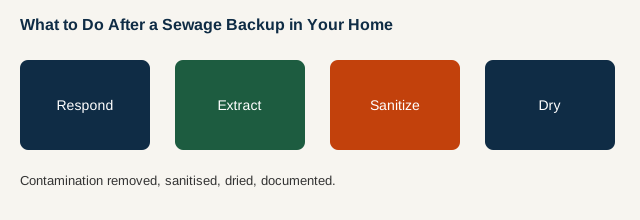
What happens next is the protocol the rest of this site describes: the spread mapped, the scope written, contaminated water extracted, unsalvageable materials removed, the structure sanitised and dried under measurement. Homeowners who have done the first hour well meet that protocol with a smaller event and a stronger claim than those who have not, which is why this post exists to be read before it is needed.
Keep this page for the household the way you would keep the water shutoff's location: unglamorous knowledge that is priceless exactly once. A sewage backup handled well is a bad week. Handled badly in its first hour, it can become a season.
The public guidance collected by https://www.epa.gov/npdes/sanitary-sewer-overflows-ssos runs through both posts: treat the contamination seriously, and document everything. If you would like the facts for your own event, an assessment answers what to do after a sewage backup with a map and a written scope instead of opinions.
Frequently asked questions
Does this apply outside Fort Pierce?
The protocol applies anywhere. The local pressure, storm surcharge, high water table and septic districts, is Fort Pierce's, and it is why the response here is organised the way it is.
Can I stay in the house during a cleanup?
Usually, with the affected area isolated and the rest of the home untouched by the event. Where the event is whole-house or the household includes someone medically vulnerable, the honest advice may be a few nights elsewhere, and it is given as advice, not as a sales lever.
What does what to do after a sewage backup have to do with my insurance claim?
Documentation is the bridge: insurers pay for evidenced damage and evidenced remediation. Photographs, moisture readings and an itemised scope are the difference between a claim that settles and one that argues.
Sewage backup in Fort Pierce? Call now.
Available 24/7. You talk with the provider directly before any work is agreed.