
Home › Blog
Black Water Health Risks: What Sewage Exposure Does
Black water health risks: sewage is treated as a health event by everyone who regulates it, and this is the plain account of why: what the water carries, how exposure happens, and who has to be most careful
Start with what is in the water. Sewage is the household and the street's waste stream: it carries bacteria from the human gut in enormous numbers, viruses that cause gastrointestinal and other illness, parasites whose eggs survive in the environment, and whatever chemicals the catchment poured into the same pipes. Flood water that has crossed ground adds soil organisms and the contents of every septic field and fuel spill on its route. None of this is visible, which is precisely the risk: black water's hazard is entirely in its contents, not its colour.
Exposure happens by routes people underestimate. Skin contact is the obvious one, and broken skin is an open door. Hand-to-mouth contact is the common one: a contaminated hand, a sandwich, a child's thumb. Aerosols are the subtle one: disturbing contaminated water, hosing it, even flushing near it, puts fine droplets into air that is then breathed. And the fourth route is time: contamination left in materials keeps exposing the household for as long as it remains, at low level, every day.
The illnesses are mostly gastrointestinal, cramps, diarrhoea, vomiting, and they are miserable rather than exotic, but the range does not end there: skin and wound infections, respiratory irritation from the aerosols and the growth that follows damp contamination, and more serious outcomes for the wrong host. Most healthy adults weather an accidental exposure with a bad few days. The point of the protocol is that nobody should have to, and that some households contain people for whom a bad few days is not the worst case.
Those households deserve naming: homes with infants and small children, who live closer to floors and put the world in their mouths; elderly residents; anyone immunocompromised by illness or treatment; and anyone with open wounds or skin conditions. For these homes the standard advice tightens: out of the affected area entirely, no helping with the cleanup, and a lower threshold for staying elsewhere until the verification readings say the property is back. That is not alarm; it is the same risk arithmetic every hospital uses.
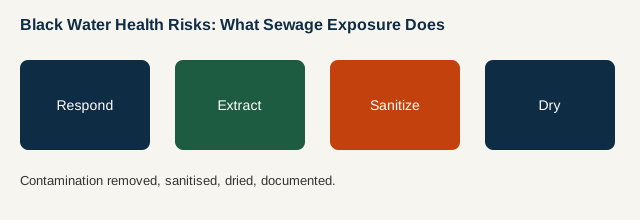
This is also why the professional protocol is built the way it is. Protective equipment is not theatre; it is the barrier between the crew and the exposure routes above. Removal of soaked porous materials is not upselling; those materials cannot be disinfected through their depth, and leaving them leaves the exposure in place. Antimicrobial treatment after cleaning is not a flourish; it is the phase that addresses the organisms the eye cannot audit. Each step answers a specific route of harm.
Household bleach and enthusiasm do not substitute, and the reasons are mechanical. Bleach is consumed by organic matter before it reaches the organisms in depth, it does not penetrate porous material, and its fumes add a respiratory insult in an enclosed, contaminated space. A surface that smells bleached can still be biologically loaded an eighth of an inch down, which is where the carpet pad, the drywall paper and the subfloor keep their share of the event.
The measured conclusion is neither panic nor casualness. A sewage event in a home is a genuine health exposure that a defined protocol exists to end, and ended properly, it ends: the verification readings and the removal record are the household's evidence that the exposure is over. The households that fare worst are not the ones with the biggest events; they are the ones whose events were treated as cleaning problems, and lingered.
If you take one sentence from this post, take the sequence: keep people clear, do not spread it, document it, and let the response be a procedure. The water's contents are the reason every part of that sequence exists, and respecting them is not fear of the water; it is simply the same arithmetic the professionals, the regulators and the insurers all run, because they have all seen how the story ends when the contents are ignored for a week and discovered in the walls a season later.
The public guidance collected by https://www.epa.gov/npdes/sanitary-sewer-overflows-ssos runs through both posts: treat the contamination seriously, and document everything. If you would like the facts for your own event, an assessment answers black water health risks with a map and a written scope instead of opinions.
Frequently asked questions
Does this apply outside Fort Pierce?
The protocol applies anywhere. The local pressure, storm surcharge, high water table and septic districts, is Fort Pierce's, and it is why the response here is organised the way it is.
Can I stay in the house during a cleanup?
Usually, with the affected area isolated and the rest of the home untouched by the event. Where the event is whole-house or the household includes someone medically vulnerable, the honest advice may be a few nights elsewhere, and it is given as advice, not as a sales lever.
What does black water health risks have to do with my insurance claim?
Documentation is the bridge: insurers pay for evidenced damage and evidenced remediation. Photographs, moisture readings and an itemised scope are the difference between a claim that settles and one that argues.
Sewage backup in Fort Pierce? Call now.
Available 24/7. You talk with the provider directly before any work is agreed.